
nhật bản BỆNH HOẠN
Bát sứ hư hỏng
Ugly Asian Male: On Being the Least Attractive Guy in the Room
Statistically, I’m the least attractive person in the dating scene. Alongside black women, the Asian-American male is considered the most ugly and undesirable person in the room. Take it from Steve…
 jsparkblog.com
Ugly Asian Male: On Being the Least Attractive Guy in the Room

Statistically, I’m the least attractive person in the dating scene. Alongside black women, the Asian-American male is considered the most ugly and undesirable person in the room.
Take it from Steve Harvey, who won’t eat what he can’t pronounce:
“‘Excuse me, do you like Asian men?’ No thank you. I don’t even like Chinese food. It don’t stay with you no time. I don’t eat what I can’t pronounce.’”
Eddie Huang, creator of the groundbreaking Asian-American sitcom Fresh Off the Boat, responded to Steve Harvey in The New York Times:
Asian-American men, like me, know the score. That is, we don’t count at all.“[Every] Asian-American man knows what the dominant culture has to say about us. We count good, we bow well, we are technologically proficient, we’re naturally subordinate, our male anatomy is the size of a thumb drive and we could never in a thousand millenniums be a threat to steal your girl.”
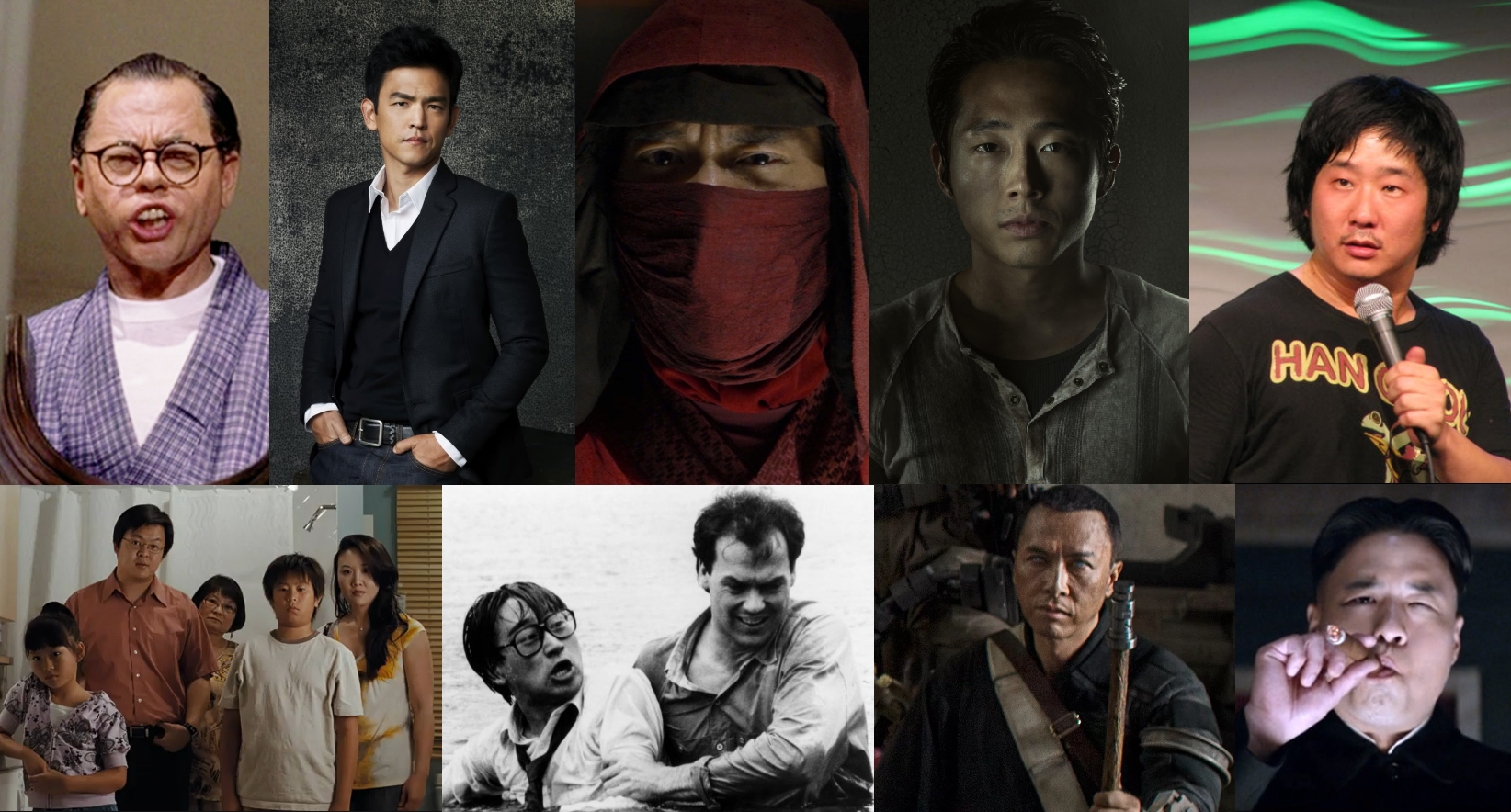
Hollywood won’t bank on me. Think: When was the last time you saw an Asian male kiss a non-Asian female in a movie or TV show? Or when was the last time an Asian-American male was the desired person in a romantic comedy? And more specifically, when where they not Kung Fu practitioners or computer geniuses? I can only think of two examples: Steven Yeun as Glenn from The Walking Dead and John Cho as Harold from Harold and Kumar Go to White Castle. So it takes either a zombie apocalypse or the munchies to see a fully breathing Asian male lead, or a Photoshop campaign #StarringJohnCho for an Asian protagonist with actual thoughts in his head.
It’s so rare to see a three-dimensional Asian male character, with actual hopes and dreams, that Steven Yeun remarks in GQ Magazine:
Growing up, I never had that, either. I can’t help but think of this scene from the biopic, Dragon: The Bruce Lee Story, in which Bruce Lee watches the controversial Asian stereotype played by Mickey Rooney in Breakfast at Tiffany’s to a theater filled with derisive laughter. This moment with Bruce Lee is most likely fictional, but the weight of it is not lost on us:GQ Magazine: When you look back on your long tenure on The Walking Dead, what makes you proudest?
Steven Yeun: Honestly, the privilege that I had to play an Asian-American character that didn’t have to apologize at all for being Asian, or even acknowledge that he was Asian. Obviously, you’re going to address it. It’s real. It’s a thing. I am Asian, and Glenn is Asian. But I was very honored to be able to play somebody that showed multiple sides, and showed depth, and showed a way to relate to everyone. It was quite an honor, in that regard. This didn’t exist when I was a kid. I didn’t get to see Glenn. I didn’t get to see a fully formed Asian-American person on my television, where you could say, “That dude just belongs here.” Kids, growing up now, can see this show and see a face that they recognize. And go, “Oh my god. That’s my face too.”
This was a powerful moment for me as a kid, because I grew up with the same sort of mocking laughter, whether it was watching Short Round in Indiana Jones and the Temple of Doom with my white neighbors, or being assailed by the Bruce Lee wail in the local grocery store. I knew they were laughing at me, and not with.
“But hey wait!”—I’m told, with fervent knowing, “I know some Asian guys who are hot!” and I’m pointed to an infamous Buzzfeed list that shows “the hottest Asian men who will prove you wrong about Asian men,” with zero irony. Yes, I’ve seen the list. And yes, they’re like I expected: hard-rock glistening abs that are impossible for the working Asian dad, with classically European, chiseled faces and surgically-lifted eyes. More than that, it plays into the same creepy objectification of Asians as sexual play-toys.
Perhaps even worse than the portrayal of Asian men is how they’re not. More often, an acting role becomes “whitewashed” to suit a global audience, or an Anglo-American is the audience-avatar as a safety net for box office returns (remember, the last samurai in The Last Samurai was white).
I know this is a shrill, ill-discussed subject with all kinds of variables, but from the prosthetic slanted eyes in Cloud Atlas to race-bleaching in Ghost in the Shell to the the “Yellow Peril” demonizing of Asian males as evil ninjas and drug dealers in Daredevil and Iron Fist, Asian-Americans—especially males, as females can still literally serve as co-stars—are vastly both mis- and under-represented. We’re used for a footnote joke at the Academy Awards (the same year that there was a campaign called #OscarsSoWhite), an overly loud insane person in raunchy comedies like The Hangover or Saving Silverman, or a “funny foreigners” punchline in the falsely interpreted romantic comedy, 500 Days of Summer.
One of the obvious reasons that Asian-Americans are sidelined in the mainstream is because there’s no money in it. It’s that simple. Freddie Wong, in his parody video of Ghost in the Shell casting Scarlett Johansson, says it best:
“Because, as a studio executive, the immorality of whitewashing a beloved work of Japanese culture is outweighed by my fear that audiences won’t want to watch a movie starring an Asian woman. And I don’t have the balls to take that risk. Besides, whatever political outrage this decision evokes doesn’t materially effect how much money I make.”


